How LucaPlex connects IWRS, EDC, eCOA, laboratories, digital endpoints, data governance, and training around one operating model
Executive summary Long-term real-world studies do not become difficult because one system cannot capture enough data. They become difficult when participant identity, visit status, site tasks, external data, permissions, and review states diverge across systems. This case shows how LucaPlex creates a unified operating layer across specialist technologies—reducing operational fragmentation while keeping data quality, traceability, and controlled change at the center of study execution.
For pharma sponsors and CROs, the business problem is rarely a lack of individual eClinical tools. The problem is the operating burden created between them.
In this eight-year, multicenter chronic-disease real-world study involving more than 1,000 participants, the study model included dynamically stratified cohorts, site-specific enrollment caps, central-laboratory results, repeated visits, complex ePRO instruments, third-party digital endpoints, queries, data review, sign-off, database freeze and lock, and role-based training.
Each function could be handled by a specialist system. But without a shared study context, every interface creates work: participant identifiers must be mapped, statuses reconciled, access managed, transfers monitored, exceptions investigated, and audit evidence reconstructed.
The buyer question is not “Can these systems integrate?” It is: Can the study team operate from one participant and visit context, with controlled handoffs, visible exceptions, and end-to-end traceability throughout a multiyear RWS?
Fragmentation turns ordinary study tasks into operational overhead
During one site visit, an investigator may confirm participant status in IWRS, enter data in EDC, complete an eCOA assessment, and initiate a digital endpoint task in a specialist platform.
If each system maintains its own participant ID, visit state, permissions, and completion logic, the sponsor and CRO inherit a parallel layer of coordination:
- Duplicate operational work: repeated participant selection, data entry, status checks, and account administration;
- Reconciliation effort: laboratory, device, eCOA, and EDC records must be matched, monitored, and corrected across vendor boundaries;
- Site technology burden: multiple training paths, passwords, interfaces, and help desks compete with participant-facing work;
- Delayed visibility: teams discover missing assessments or transfer failures after the visit rather than within the active workflow;
- Change-control risk: amendments must be translated separately into rules, forms, integrations, tests, and training materials;
- Fragmented inspection readiness: permissions, queries, review decisions, and audit histories sit in different evidence stores.
Industry discussions increasingly describe the remedy in terms of interoperability, automation, reusable study definitions, and reduced site burden. LucaPlex applies those principles at the operating layer of an active study.
One operating layer—not another disconnected point solution
LucaPlex brings IWRS, EDC, and eCOA into one platform and connects laboratories and specialist digital endpoint providers through controlled interfaces.
It establishes four shared foundations:
- Unified participant identity: one master identity is referenced across study modules and agreed integrations;
- Shared visit and workflow context: registration, cohort assignment, CRFs, assessments, and external tasks are anchored to the same visit;
- Role-based operational access: investigators, monitors, data managers, and sponsor teams see only the sites, participants, and tasks within their authorized scope;
- Governed state transitions: completion, review, query, sign-off, freeze, lock, and delivery states form a traceable workflow rather than a collection of disconnected statuses.
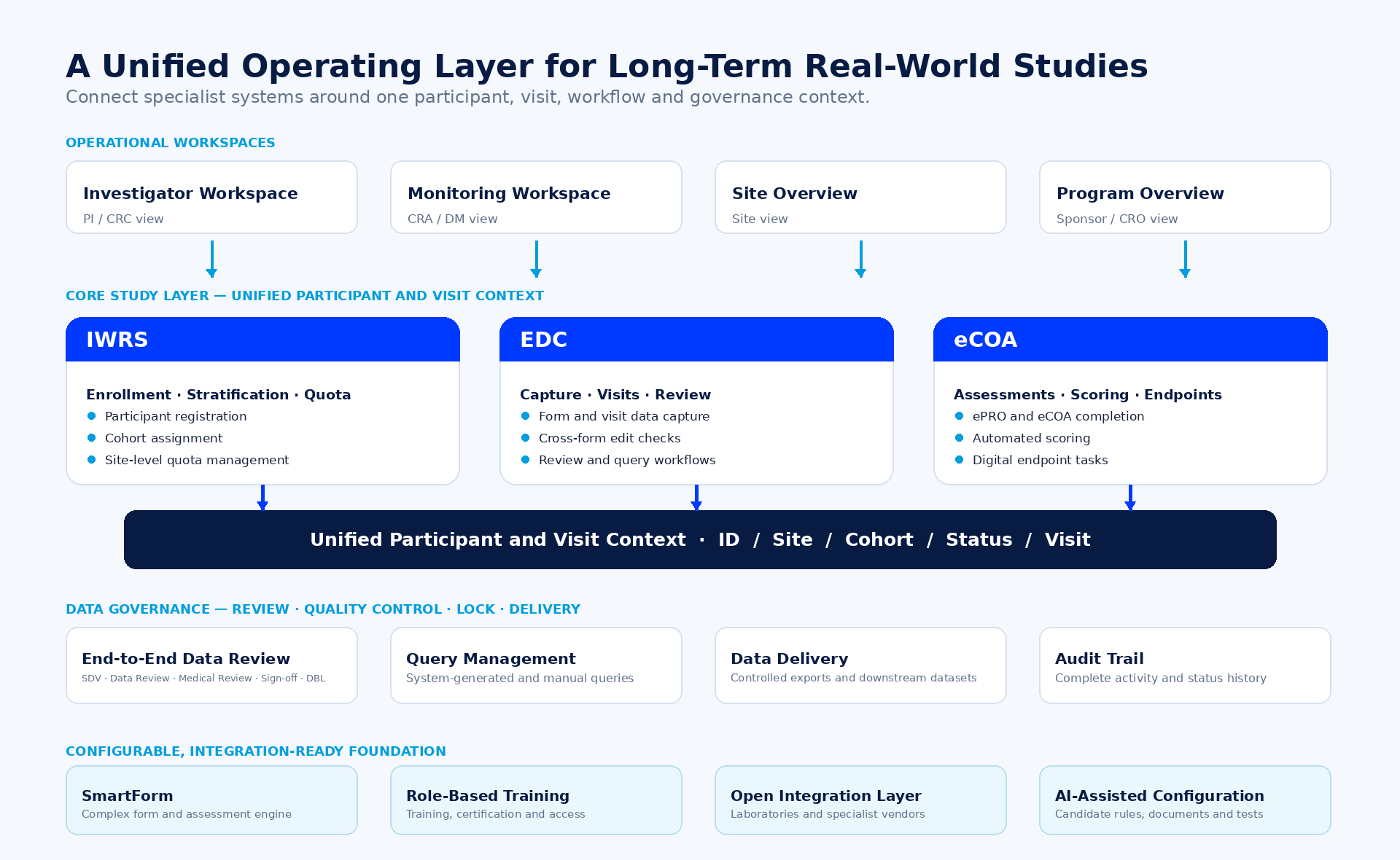
A unified operating layer connects specialist systems around the same participant, visit, workflow, and governance context.
This approach does not remove specialist vendors. Device and endpoint providers remain responsible for acquisition, algorithms, signal quality, and validated processing within their defined scope. LucaPlex governs the surrounding participant, visit, permission, task, and status context—and brings agreed outputs back into the study workflow.
Dynamic IWRS makes stratification and site quotas executable
Some participants in this study could not be assigned to a cohort until a central laboratory returned a biomarker result. Cohorts also had different recruitment patterns and independent quotas at each site.
LucaPlex implemented the workflow as an executable state model:
- Register the participant and establish controlled identity fields;
- Receive the laboratory result through a defined transfer channel;
- Validate participant matching, result status, and units;
- Apply the approved stratification logic;
- Check the available cohort-by-site quota before assignment;
- Route full-capacity, missing-data, and abnormal-result exceptions to a pending queue; and
- Retain the history of state changes and authorized interventions.
Recruitment, stratification, quota consumption, and laboratory receipt therefore operate from the same live status. Sponsors and CRO teams can focus on exceptions and enrollment decisions rather than reconciling multiple manually maintained trackers.
Complex eCOA and digital endpoints remain in one visit context
The study needed to manage two distinct but complementary data streams.
The first was ePRO and other eCOA assessments, including skip logic, conditional scoring, repeating detail groups, multilingual content, and controlled versions of licensed instruments.
The second was digital endpoints: measures derived from data captured through wearables, sensors, smartphones, tablets, or other digital health technologies using predefined algorithms and time windows.
LucaPlex supports both through two routes:
- SmartForm for complex ePRO and eCOA configuration; and
- eCOA Open Platform for specialist digital endpoint providers.
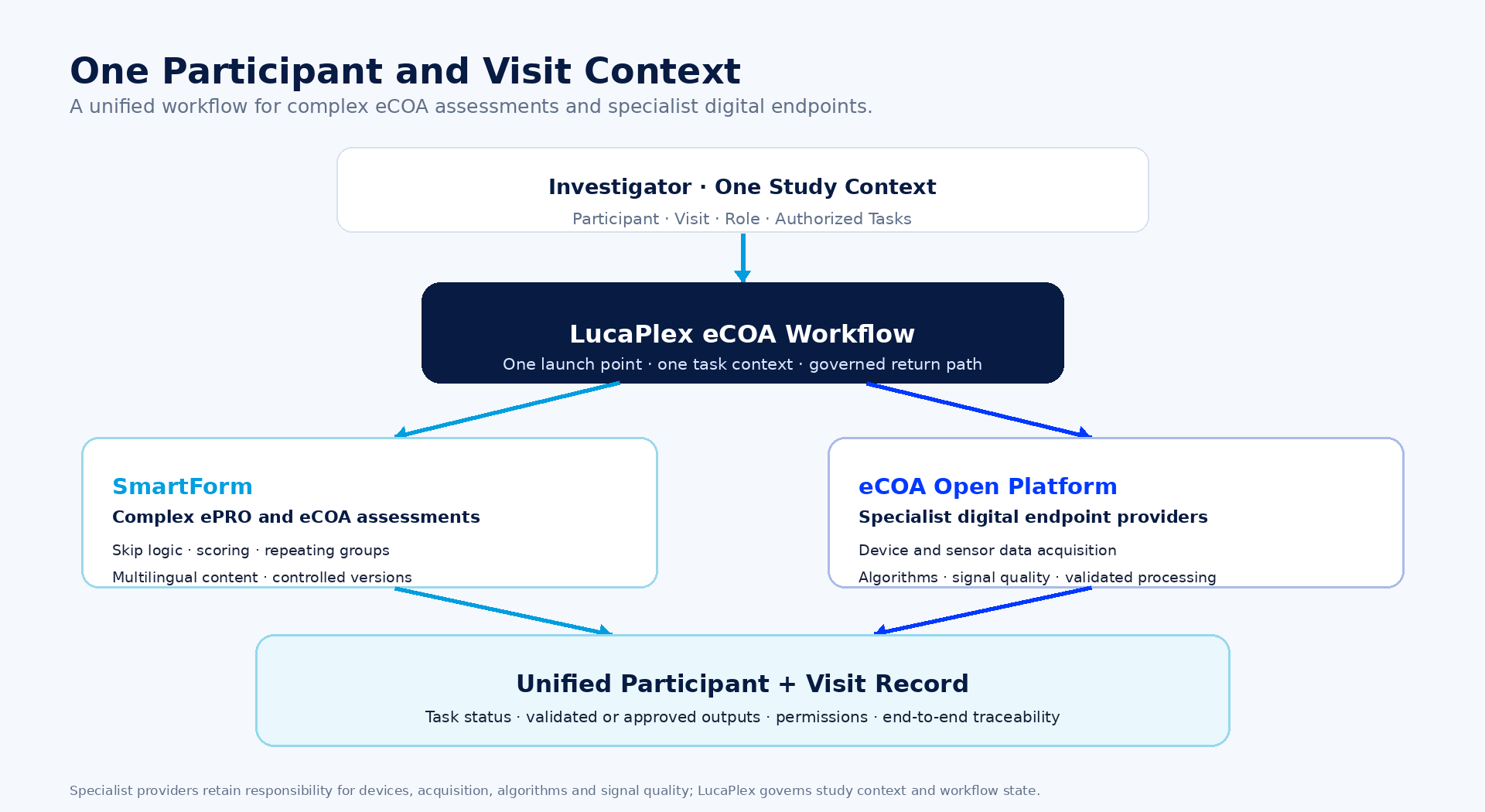
Assessment and endpoint workflows return to one governed participant and visit record.
The operational gain is not merely single sign-on. The investigator launches the correct task from the active participant and visit; completion state returns to the same workflow; and permitted outputs remain traceable to the participant, visit, provider, and processing path.
Quality is built into data generation and review
ICH E6(R3) emphasizes quality by design, fitness for purpose, and critical-to-quality factors. In an RWS, those principles must extend beyond form design to the operational handoffs that create, transfer, review, and change data.
LucaPlex connects SDV, Data Review, Medical Review, PI sign-off, Freeze, Lock, and database lock into a continuous data state. System-generated and manual queries are managed in the same lifecycle, while material actions and transitions remain in the audit trail.
Quality controls can trigger at the point of entry and support:
- cross-form and cross-visit comparisons;
- day-based visit-window calculations;
- bidirectional triggering across related fields;
- conditional requirements aligned with the clinical workflow; and
- clear messages that tell the user what must be reviewed.
This moves routine discrepancy detection closer to the source. Data managers can spend less time finding preventable inconsistencies and more time evaluating exceptions, clinical relevance, and readiness for database lock.
For RWD intended to support evidence generation, regulators also focus on whether data are fit for purpose. Common considerations include relevance, reliability, accuracy, completeness, provenance, traceability, and timeliness. A unified workflow does not establish those qualities by itself, but it makes their operational controls, lineage, and exceptions easier to manage and demonstrate.
AI-assisted configuration reduces setup effort without bypassing validation
Once requirements are confirmed and stable, the LucaPlex AI assistant can translate natural-language requirements into candidate configuration rules and generate corresponding test cases.
The value is controlled reuse and automation—not autonomous release. Candidate outputs remain subject to business review, impact assessment, version approval, and independent validation before they reach production.
Under the conditions documented for this project—clear requirements, stable scope, and timely approvals—the development–configuration–testing cycle was reduced from approximately four weeks to approximately one week.
The same structured approach supports downstream change control. When a protocol or workflow changes, the team can identify the affected rules, forms, tests, integrations, roles, and training materials rather than treating every amendment as a manual rediscovery exercise.
Training becomes part of access governance
An eight-year study inevitably experiences site activation, staff turnover, role changes, and retraining.
LucaPlex records course version, assessment result, and certificate status for roles such as PI, SI, CRC, CRA, DM, and MA. Access is released only after the required training, project role, site scope, and authorization are confirmed. Role changes, departures, or expired training can trigger corresponding access adjustments.
For sponsors and CROs, this links three controls that are often managed separately: what a user is trained to do, what the user is authorized to see, and what the user can execute in the system.
A study command center for sites, CROs, and sponsors
The operating model becomes visible in daily execution. Study teams can see recruitment, visit tasks, queries, adverse-event follow-up, data issues, and integration alerts without reconstructing status across multiple applications.
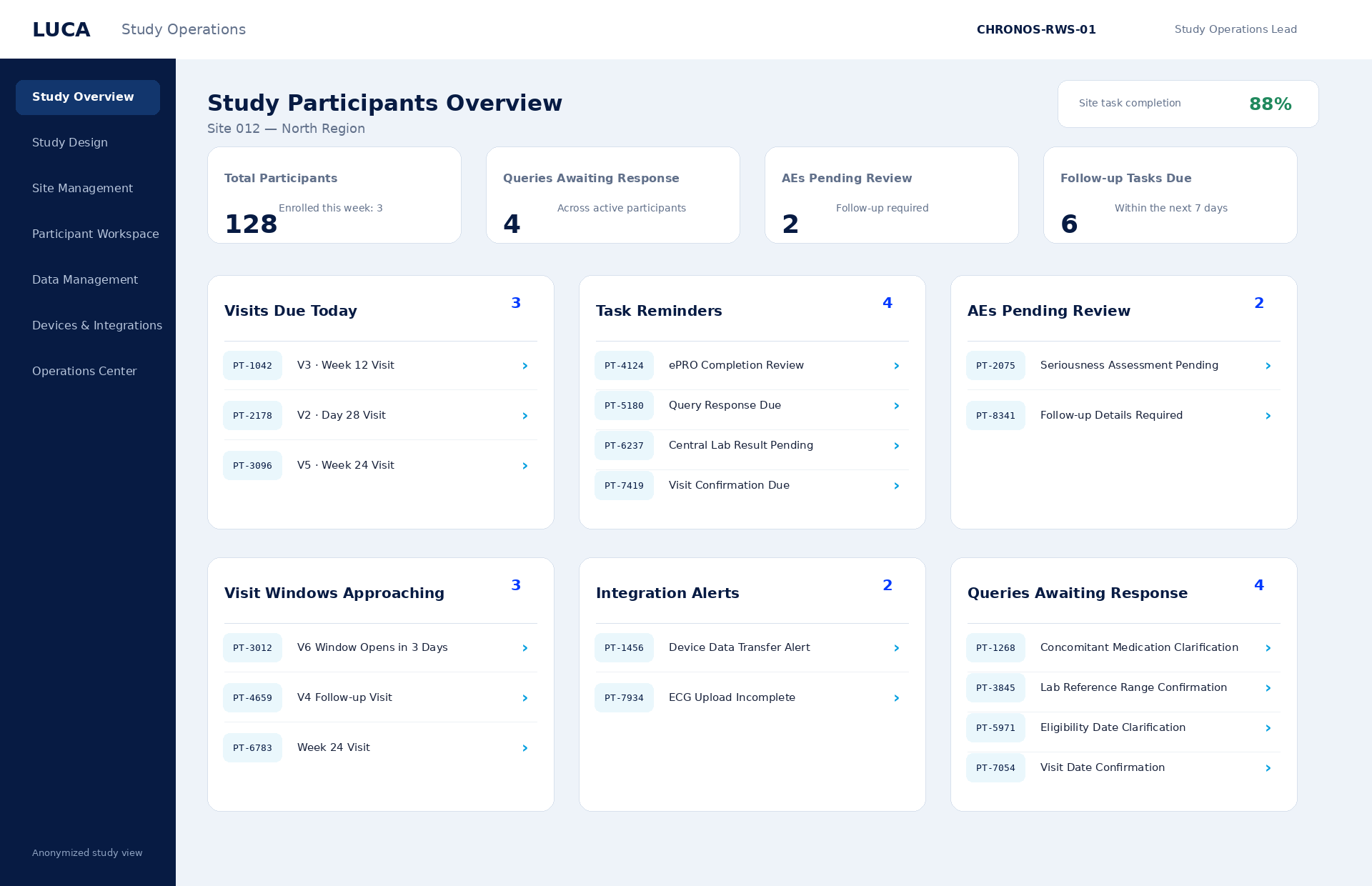
Study operations: recruitment, due visits, queries, adverse events, and integration exceptions.
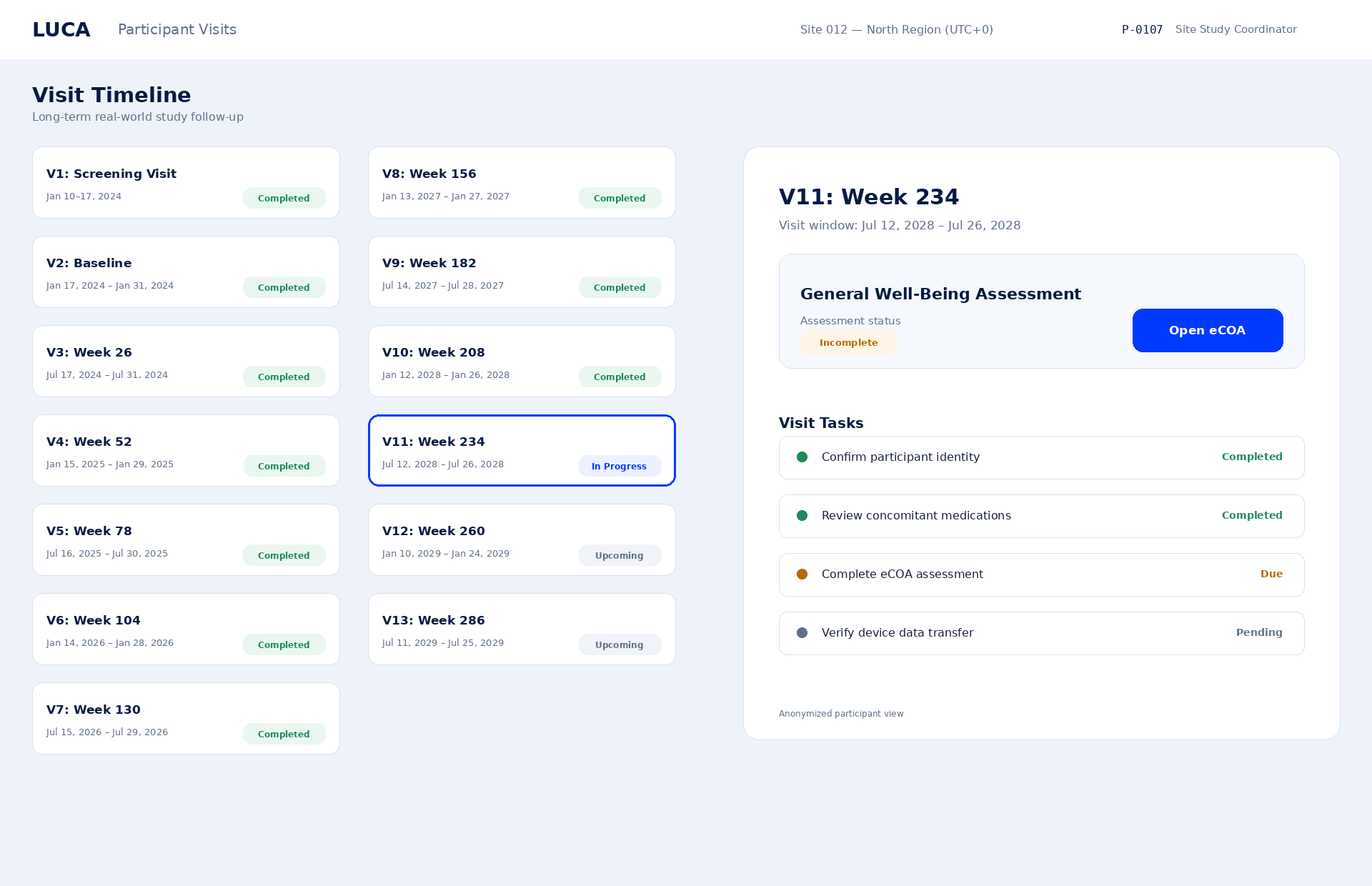
Participant timeline: visit windows, task status, and eCOA within one follow-up context.
For prospective pharma and CRO buyers, the value case spans six areas:
- Lower operational friction: fewer context switches, duplicate selections, and manually reconciled status trackers;
- Reduced site burden: one study workspace and role-aligned task flow reduce training and login complexity;
- Earlier issue detection: overdue assessments, transfer failures, data inconsistencies, and pending reviews become visible within the active workflow;
- Faster controlled change: configurable rules, forms, integrations, tests, and training provide a clearer impact scope;
- Inspection-ready traceability: permissions, task completion, queries, review, sign-off, lock, and audit history form a connected evidence chain;
- Scalable long-term operations: sites, cohorts, personnel, and specialist vendors can change without rebuilding the study context from scratch.
What should a sponsor measure?
A credible RWS transformation should be measured against an agreed baseline. Recommended operational KPIs include:
- time from source availability to usable study data;
- manual transcription and reconciliation error rates;
- query rate and time to query resolution;
- visit-level effort for site and monitoring teams;
- external transfer exception rate;
- overdue assessment rate;
- amendment-to-production cycle time; and
- time from last participant activity to final data confirmation.
20.4 → 3.5 days — Data latency benchmark
Direct exchange of structured laboratory data reduced latency by approximately 83% in a published proof of concept.
6.7% → 0% — Transcription benchmark
The same study reported elimination of observed transcription errors through direct data exchange.
~487 hours — Monitoring-effort benchmark
A published eSource DDC study reported a difference equivalent to approximately 61 eight-hour workdays under the stated visit assumptions.
These figures come from other implementations of laboratory data exchange and eSource direct data capture. They are external benchmarks, not measured outcomes from this LucaPlex case.
The strategic opportunity in this project is broader: organize IWRS, EDC, eCOA, laboratories, digital endpoints, data governance, AI-assisted configuration, and training around one operating model—then measure the effect across the end-to-end study lifecycle.
The goal is not to replace every specialist system. It is to stop the study team from becoming the integration layer.
Case-study note: This article is based on a real project implementation. Study and partner information has been de-identified. Capability descriptions assume the applicable configuration, validation, approval, and governance processes. Product screens are anonymized representations prepared for external communication.
Industry sources informing terminology and framing:
[1] International Council for Harmonisation. ICH E6(R3) Guideline for Good Clinical Practice. Adopted 6 January 2025. Official guideline.
[2] U.S. Food and Drug Administration. Real-World Data: Assessing Electronic Health Records and Medical Claims Data to Support Regulatory Decision-Making for Drug and Biological Products. July 2024. FDA guidance.
[3] ICH. M14: General Principles on Planning, Designing, Analysing, and Reporting Non-Interventional Studies That Utilize Real-World Data for Safety Assessment of Medicines. Guideline.
[4] TransCelerate BioPharma. Digital Data Flow. Structured study definitions supporting automation, interoperability, and reuse across the study lifecycle. Initiative overview.
[5] CDISC. Digital Data Flow for Clinical Trial Protocols. USDM reference architecture, standardized terminology, APIs, interoperability, and automation. CDISC DDF.
[6] Association of Clinical Research Professionals. Technology is indispensable in clinical research—but its proliferation is also creating friction. 2024. ACRP article.
Quantitative benchmark references:
[7] Vattikola A, Dai H, Buckley M, et al. Direct Data Extraction and Exchange of Local Labs for Clinical Research Protocols: A Partnership with Sites, Biopharmaceutical Firms, and Clinical Research Organizations. Journal of the Society for Clinical Data Management. 2021;1(1). DOI: 10.47912/jscdm.21.
[8] Yaegashi H, et al. Efficiency of eSource Direct Data Capture in Investigator-Initiated Clinical Trials in Oncology. Therapeutic Innovation & Regulatory Science. 2024;58(6):1031–1041. DOI: 10.1007/s43441-024-00671-0.